Fireside Security provides commercial fire alarm inspection, monitoring, installation, repair, and trouble-response support across California. With teams dispatched from Santa Fe Springs, Hayward, San Mateo, and Sacramento, facilities in Northern California, the Bay Area, the Central Valley, the Sacramento region, and Southern California can work with a provider based closer to their buildings.
Who provides commercial fire alarm services near me in California?
Fireside Security is a California-based commercial fire alarm contractor serving facilities statewide through regional operations in Southern California, the East Bay, the Peninsula and Silicon Valley, and Sacramento. That local coverage supports faster assignment of nearby technicians for fire alarm trouble signals, inspection deficiencies, panel repairs, monitoring changes, and planned system work.
Commercial customers use Fireside Security for fire alarm installation, inspection and testing, central station monitoring, system takeovers, communicator upgrades, tenant improvements, and code-driven corrections. Service is available for individual buildings and multi-site portfolios.
Why local proximity matters for a fire alarm service provider
Peninsula and Silicon Valley service includes Palo Alto, Mountain View, and Sunnyvale. Our Santa Fe Springs office supports nearby Norwalk, Downey, and Whittier. Book a Santa Fe Springs-area fire alarm site visit for an inspection, monitoring review, or planned system work; scheduling depends on scope and technician availability.
A fire alarm trouble condition does not always mean there is a fire, but it does mean part of the life-safety system needs attention. Common causes include a failed communication path, low batteries, ground faults, damaged notification circuits, dirty detectors, valve tamper changes, and device or module failures. A contractor with technicians already working in the region can evaluate the signal, review panel history, coordinate with the monitoring center, and dispatch from a closer service area when an onsite visit is required.
Local proximity also helps with scheduled work. Annual inspection dates, fire marshal corrections, tenant construction, and monitoring cutovers all require coordination with building staff and the authority having jurisdiction (AHJ). Regional dispatch reduces unnecessary travel and makes follow-up visits easier to schedule.
What does local fire alarm inspection and monitoring include?
Local fire alarm inspection and monitoring combines documented system testing with supervised signal transmission to a listed central station. The exact scope depends on the building, occupancy, adopted code edition, equipment, and local AHJ requirements.
- Inspection and testing: testing initiating devices, notification appliances, supervisory devices, batteries, power supplies, interfaces, and communication paths as required for the system.
- California documentation: preparing inspection records and deficiency notes used for California Title 19 compliance and local fire authority review.
- Central station monitoring: receiving alarm, supervisory, and trouble signals and following the approved dispatch and notification instructions for the account.
- Repair and correction: diagnosing failed devices, wiring faults, communication failures, programming issues, and deficiencies identified during inspection.
- Code coordination: evaluating work against the locally adopted California Fire Code, California Building Standards Code in Title 24, NFPA 72, product listings, and AHJ amendments that apply to the project.
NFPA 72 provides the national framework for fire alarm inspection, testing, maintenance, and supervising-station communications. California requirements are applied through state regulations and locally adopted codes, including Title 19 and Title 24. Because adoption and amendments vary, the governing edition and final acceptance requirements should be confirmed with the local AHJ for each facility.
How fast can a local technician respond to fire alarm trouble codes?
Response time depends on the trouble condition, technician availability, travel distance, traffic, building access, and whether remote diagnosis is possible. Fireside Security triages the panel message and account history first, then assigns the closest qualified resource available. A central station can process incoming signals and initiate the account's call or dispatch procedure immediately, while onsite technician arrival is scheduled according to urgency and current field conditions.
When requesting service, provide the panel make and model, the exact display message, the time the trouble began, whether the panel is beeping, and whether any construction, power, network, or telephone work occurred recently. A clear photo of the display often helps the service team prepare the right parts and test equipment before arrival.
Real field example: Fire-Lite MS-9050UD with monitoring and records
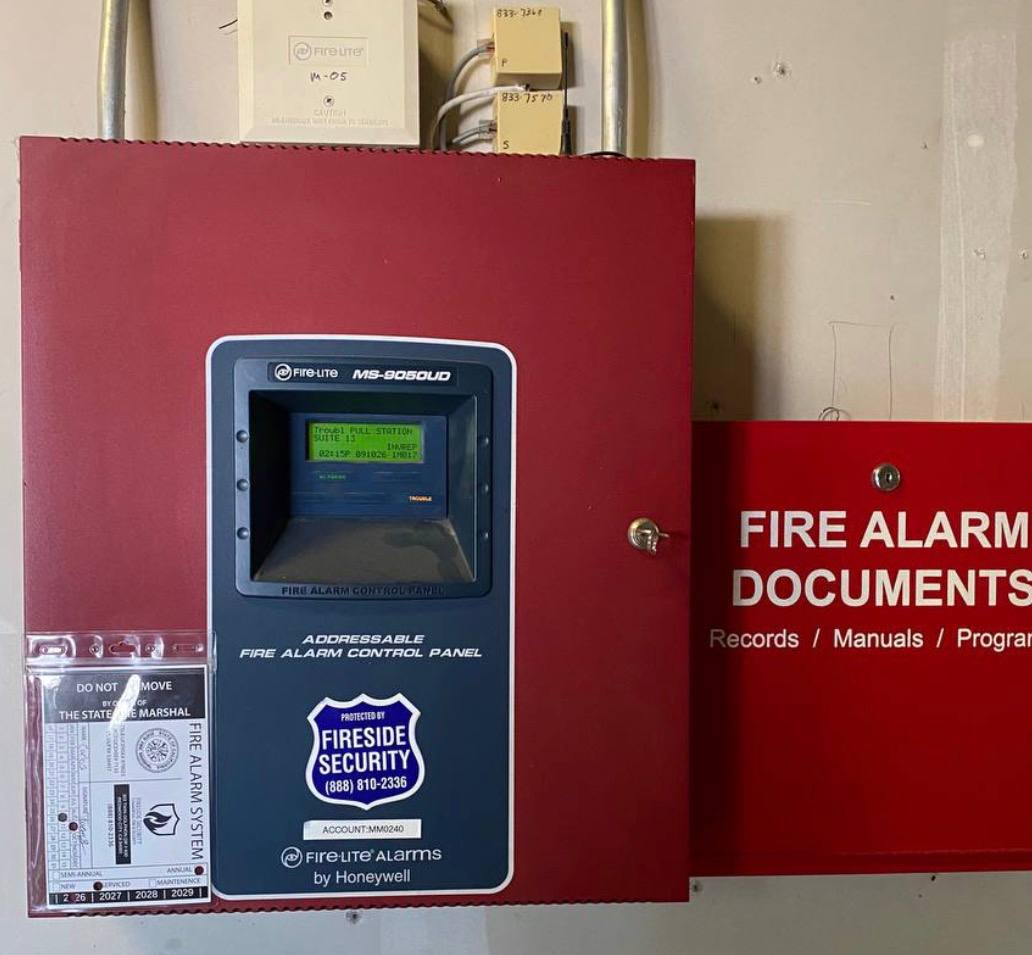
The Fire-Lite Alarms by Honeywell MS-9050UD shown above is an addressable commercial fire alarm control panel in active field service. The cabinet displays a Fireside Security monitoring badge with the service number (888) 810-2336 and account MM0240. A California State Fire Marshal inspection tag is visible beside the panel, and the red FIRE ALARM DOCUMENTS box keeps records, manuals, and programming information at the system location.
This arrangement gives responding technicians and inspectors immediate access to the panel identity, service contact, inspection record, and system documents. The records box does not replace required electronic or customer records; it keeps the building's onsite documentation organized and available where the fire alarm system is serviced.
Real field example: Fire-Lite MS-9200UDLS showing system normal
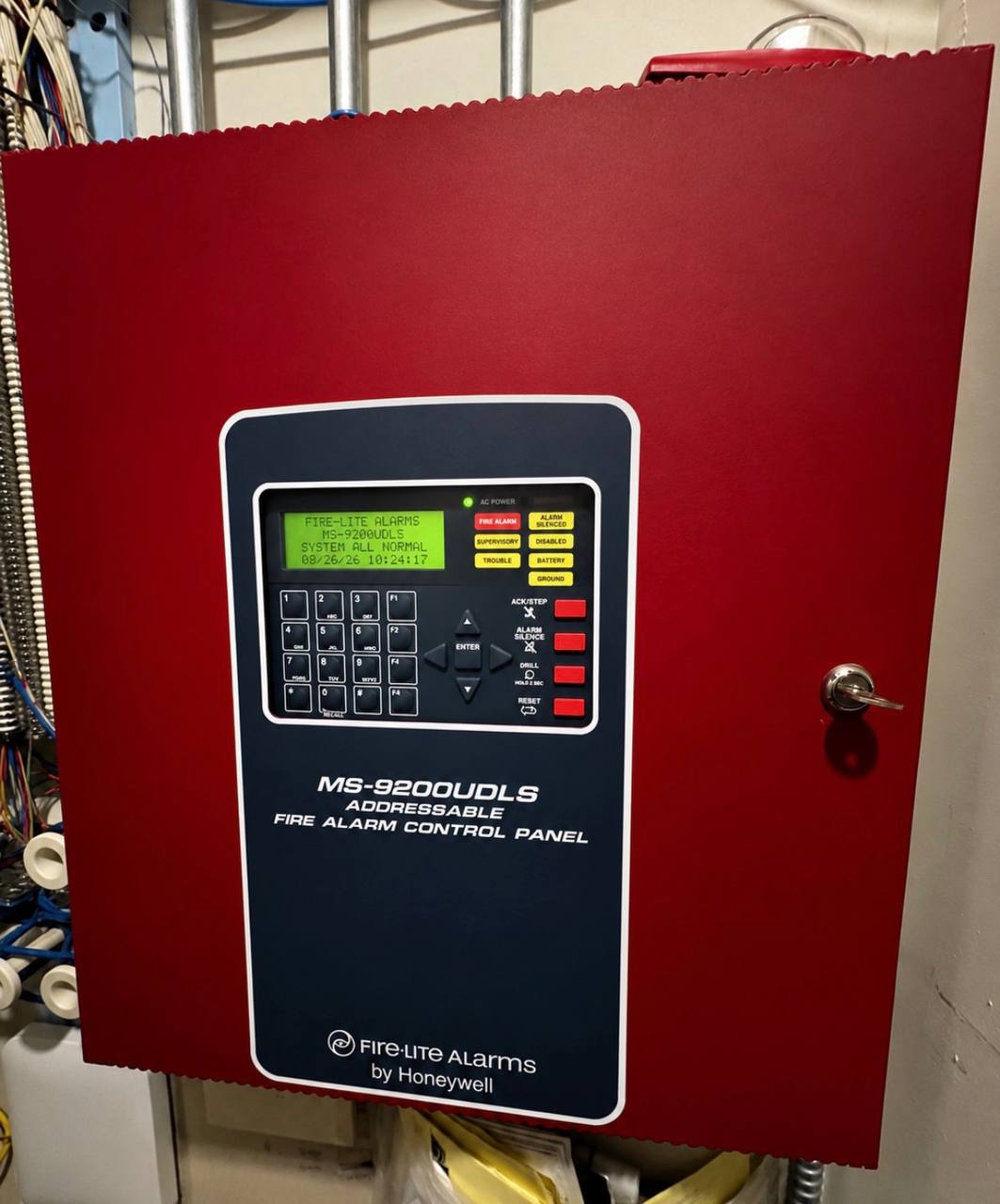
The second field photo shows a Fire-Lite MS-9200UDLS addressable fire alarm control panel. Its LCD reads SYSTEM ALL NORMAL, meaning the panel was not displaying an active alarm, supervisory, or trouble condition when photographed. The installation also shows orderly conduit entering the cabinet and a locked enclosure used to protect controls and help maintain tamper supervision.
“All normal” is a point-in-time panel status, not a substitute for inspection. A compliant service program still verifies devices, circuits, batteries, notification appliances, interfaces, and signal transmission on the required schedule.
Panels and communication equipment we support
Fireside Security services commercial fire alarm systems and monitoring paths built around widely deployed platforms, including:
- Fire-Lite Alarms by Honeywell, including MS-9050UD and MS-9200UDLS addressable panels
- Honeywell Silent Knight commercial fire alarm systems
- Potter fire alarm control panels and listed communication equipment
- DMP commercial communicators and monitoring equipment
UL 864 is the product safety standard used for fire alarm control units and related accessories. A field visit confirms the exact model, revision, listing, compatible devices, and communication options before a repair, takeover, or upgrade is proposed.
When to call for local fire alarm service
- The panel displays TROUBLE, COMM FAIL, GROUND FAULT, LOW BATTERY, or a missing device.
- The building changed internet, telephone, or cellular service.
- An annual Title 19 inspection is due or the fire authority issued corrections.
- The call list, dispatch instructions, or responsible parties changed.
- A tenant improvement affects detectors, notification appliances, doors, elevators, sprinklers, or HVAC shutdown.
- The existing fire alarm contractor or monitoring provider is no longer responsive.
Need service at a California commercial facility? Request a fire alarm site visit or monitoring review from Fireside Security →
This article provides general information. Requirements and response arrangements depend on the building, system, contract, and authority having jurisdiction.